Electricity Management
The Company places great importance on efficient energy management. In 2024, the Company carried out continuous maintenance of machinery and electrical equipment, as well as energy system improvements. It promoted energy conservation within the organization and fostered a corporate culture that encourages employees to participate in energy saving and resource conservation. The Company expanded the installation of solar power systems (Solar Rooftop) to increase the share of clean energy consumption. Energy efficiency per revenue was improved, reducing electricity consumption per revenue from 6,543 to 6,363.97 kWh/million THB, representing a 2.75%, a decrease from 2023 to 2024.
Solar Rooftop Project
The Company places great importance on conducting its business responsibly while protecting the environment and promoting the use of clean energy to support a sustainable transition toward a low-carbon society. Since 2018, the Company has continuously implemented its Solar Rooftop Project, covering key operating locations, including Index Living Mall branches, The Walk shopping centers, distribution centers, and manufacturing facilities. The project aims to increase the share of renewable energy consumption, reduce dependence on fossil fuel-based energy, and minimize environmental impacts arising from business operations.
As of the end of 2025, the Company further expanded its Solar Rooftop installations to two additional locations, namely Little Walk Krungthep Kreetha and Index Interfurn Factory, through the expansion of Phase 2, comprising Plant 5 and Plant 6.
As a result, the Company has installed Solar Rooftop systems at 29 locations nationwide, covering operational sites with strong solar energy generation potential. The Company also plans to continue expanding installations in the coming years to support business growth and long-term sustainability goals.
The Company sources electricity from only two sources:
Electricity purchased from the Electricity Generating Authority of Thailand (EGAT) and Provincial Electricity Authority (PEA); and Renewable electricity generated from Solar Rooftop systems.
The Company does not utilize electricity generated from other energy sources such as nuclear energy, oil, coal, or fuel oil.
Furthermore, the Company is not exposed to risks or impacts related to grid or transmission losses, as its business operations focus on retailing furniture, home furnishings, and household products. The Company does not generate, transmit, or distribute electricity through its own power transmission network.
In 2025, the Company generated a total of 17,315.87 megawatt-hours (MWh) of solar electricity, representing a 10.40% increase compared to 2024. Renewable energy consumption increased by 15.82% compared to the 2023 baseline year. This reflects the effectiveness of the Company's renewable energy management practices and the tangible expansion of its Solar Rooftop installations.
Through the Solar Rooftop Project, the Company reduced greenhouse gas emissions by a total of 8,107.29 tonnes of carbon dioxide equivalent (tCO2e). This initiative helped reduce reliance on non-renewable energy sources, strengthened operational resilience and energy security, and reinforced the Company's leadership in sustainability. The project is aligned with the Company's commitment to climate change mitigation and environmentally responsible business practices.
In 2025, the Company's total electricity consumption amounted to 69,612.80 MWh, comprising 52,296.93 MWh purchased from electricity utilities and 17,315.87 MWh generated from solar energy. The use of solar power reduced reliance on external electricity sources and generated electricity cost savings of THB 76,709,304.10, based on an average electricity tariff of THB 4.43 per kWh.
Regarding energy efficiency performance, the Company's electricity consumption intensity was 6,960.42 kWh per million baht of revenue, an increase of 6.37% compared to the 2023 baseline year. Electricity consumption intensity per floor area was 55.03 kWh per square meter, representing an increase of 11.28% compared to the same baseline year.
Energy Saving Program
The Company continuously implements initiatives to enhance energy efficiency across its buildings, branches, and manufacturing facilities. Key projects undertaken in 2025 include:
- Chiller Efficiency Improvement: The Company continuously evaluates and studies the operating performance of chillers to improve efficiency and reduce energy consumption.
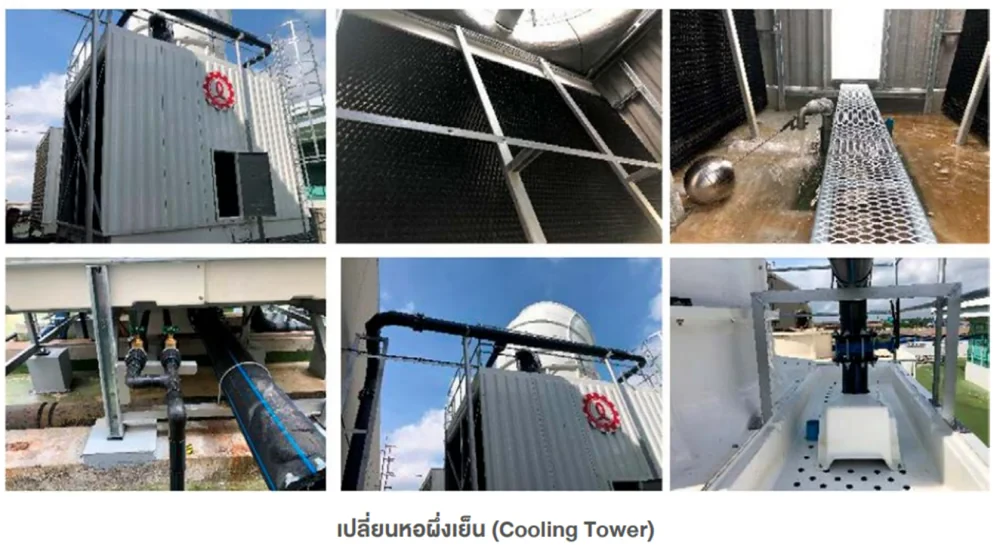
- Cooling Tower and Air Handling Unit (AHU) Optimization: Cooling towers and AHUs are regularly inspected and maintained under preventive maintenance plans to ensure optimal operating performance and energy efficiency.
- Chiller Operation Optimization: The operating parameters and airflow rates of AHUs are adjusted according to seasonal conditions to ensure suitability for weather patterns while reducing electricity consumption without affecting indoor environmental quality.
- Split-Type Air Conditioner Efficiency Improvement: When replacing outdated or malfunctioning air-conditioning units, the Company adopts energy-efficient inverter-type systems to improve energy performance and reduce electricity consumption.
- LED Lighting Replacement Program: The Company systematically replaces damaged conventional lighting with LED lighting on a quarterly basis to improve energy efficiency within its facilities.
- Branch Energy Management Measures: The Company implements energy management measures across branches, including setting appropriate indoor temperatures, controlling lighting operation schedules, and monitoring electricity consumption to maximize energy efficiency and cost-effectiveness.
- Office Electricity Saving Campaign: The Company promotes energy conservation practices among employees, including switching off lights during lunch breaks and in unoccupied areas to reduce unnecessary electricity consumption.
INDEX GOES GREEN’s Project
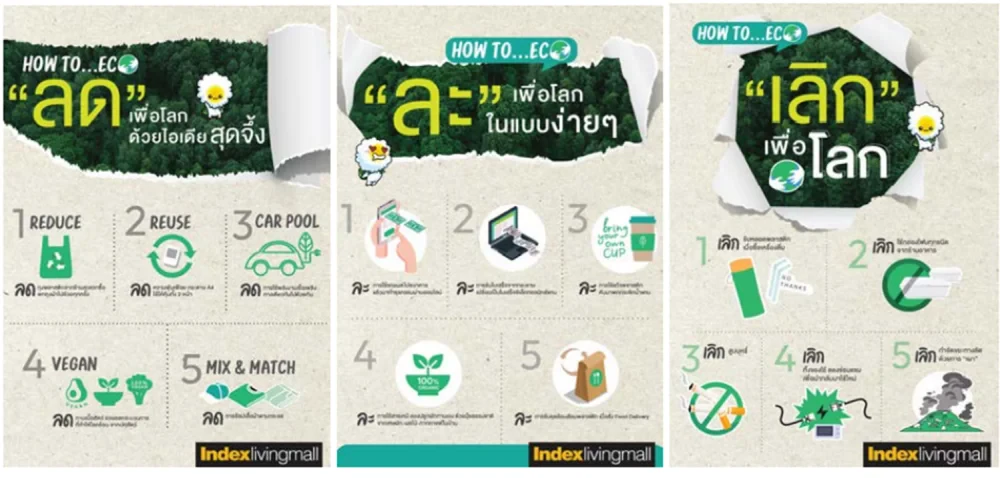
Since 2023, the Company has continuously implemented the INDEX GOES GREEN project, focusing on raising awareness among employees and management about social and environmental responsibility. This is achieved through activities and policies that promote energy conservation and resource reduction, such as reducing the use of bottled drinking water, adopting water filtration systems, limiting document printing, and transitioning to electronic systems, as well as eliminating plastic packaging. The goal is to foster an environmentally friendly corporate culture and support sustainable business operations.