


Materiality Assessment

In today’s business landscape, sustainability has become a critical framework that every organization must prioritize, not only to address the risks arising from economic, social, and environmental changes, but also to seize opportunities for creating shared value for all stakeholders.
The Company recognizes that a comprehensive and systematic identification of material topics for sustainability reflects clear direction, strategy, and goals to drive business growth in harmony with social and environmental responsibility.

Identifying and prioritizing sustainability issues is not merely a response to stakeholder expectations; it also enables effective strategic risk management. One of the key challenges the Company faces is maintaining a balance between operating in a highly competitive environment and upholding standards of transparency, responsibility, and adaptability in rapidly evolving global regulations and trends. At the same time, this process opens up opportunities to develop innovation, products, and services that are environmentally friendly,and helps build trust among investors, business partners, customers, communities, and society at large.


Therefore, determining material topics for sustainability is not simply a technical assessment. It is the foundation of long-term organizational stability, enabling the Company to achieve balanced growth, effective responses to complex challenges, and the ability to capture new opportunities
while contributing meaningfully to the United Nations Sustainable Development Goals (SDGs).
The Company places strong emphasis on identifying and managing sustainability issues relevant to its operations, considering both internal and external factors across the economic, social, and environmental dimensions, and ensuring the participation of all stakeholder groups. This approach helps ensure that the Company’s business practices respond to stakeholder expectations, align with the SDGs, and support long-term shared value creation. To achieve this, the Company has established a systematic process for determining material sustainability topics as follows:

Identification of Material Topics for Sustainability

Prioritization

Validation

Continuous Improvement
1. Identification of Material Topics for Sustainability
The Company gathers and analyzes internal factors and external trends that may affect business operations, including benchmarking against companies in the same industry, to identify key sustainability issues that are important and relevant to corporate strategy. These issues are mapped to the Sustainable Development Goals (SDGs) and aligned with international reporting standards such as the GRI Standards. The list of material topics is reviewed and updated every two years.
2. Prioritization
The identified sustainability issues are evaluated based on two key dimensions:
- Business Impact: The level of impact on the Company’s business
- Stakeholder Expectation: The level of importance perceived by stakeholders
Based on this assessment, the issues are ranked and the most significant ones are selected as “Material Topics” thatthe Company should prioritize in its business operations.
3. Validation
The company ensures the accuracy and completeness of the identified material topics through an internal validation process. The findings are presented to the Nomination, Remuneration, Corporate Governance & Sustainability Committee (NRGSC) for review, before being formally approved by the Board of Directors. This process ensures alignment with corporate strategy, and internal standards.
4. Continuous Improvement
The company is committed to continuously development and improving its process for determining material sustainability topics, in line with changing business environment and global trends. Regular reviews and updates are conducted to ensure that the identified topics reflect the Company’s key risks, emerging opportunities, and strategic sustainability objectives for the future.

Materiality Assessment
The company has identified 10 key material sustainability topics as follows:
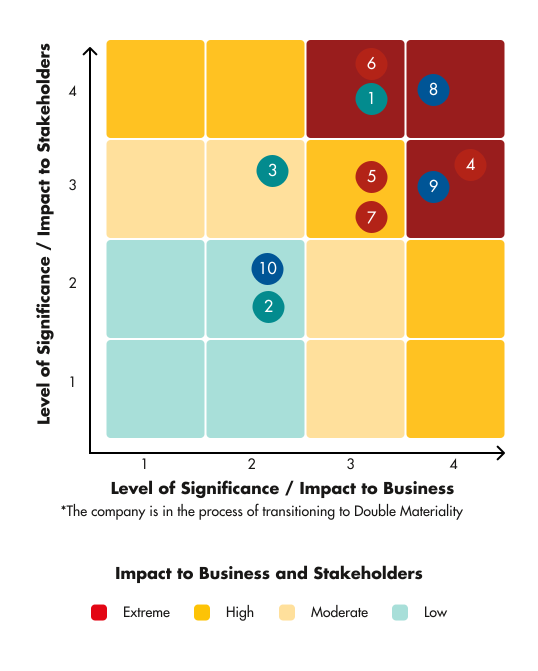
Environmental Dimension
-
1Climate change mitigation and adaptation
-
2Efficient energy management and renewable energy promotion
-
3Environmental management and pollution control
Social Dimension
-
4Responsible supply chain management
-
5Employee well-being and human capital development
-
6Occupational health and safety management
-
7Community and social engagement
Governance and Economic Dimension
-
8Customer satisfaction and experience
-
9Information security and data protection
-
10Corporate governance and anti-corruption
