

Employee Development

Supporting the SDGs Goal


Goals
Performance Highlights 2024
- conducting a Cybersecurity training course with 100% employee participation,
- fostering a learning culture by sharing organizational knowledge through the Strategic Thinking course,
- facilitating experience and knowledge exchange via online programs such as the Digital Learning Platform, Notion AI, and IndexGPT
- providing mandatory training to raise awareness and understanding of sustainable development, including courses on Anti-Corruption, Code of Conduct, and the Personal Data Protection Act (PDPA), among others.

Commitment, Challenge and Opportunity
The Company places great importance on developing employee capabilities, which are considered a key resource for driving the organization. The Company focuses on enhancing the knowledge and skills required for current job performance, while also preparing employees with the knowledge and skills necessary for the future, in order to support the organization in achieving its business goals and to create career advancement opportunities for employees at all levels.
In 2024, the Company is committed to driving sustainable employee development, focusing on enhancing employees’ knowledge and capabilities. A review and planning process for personnel development has been conducted, taking into account key factors such as economic trends, business environment, technology, and emerging risks. This has led to a rethink of employee development approaches to align with the organization’s direction and the application of technology to foster sustainable learning. The development covers three main dimensions:

At the same time, the Company is committed to elevating the learning process from traditional training methods to an integrated development approach focused on tangible behavioral change.
This ensures that employees can effectively apply the knowledge and skills gained in their work, under the concept of "Developing People, Developing Organizations Towards Sustainability." aiming to retain and nurture talented employees to grow alongside the Company.
Management and Operational Approach
The Company has established a vision for personnel development under the concept of “Develop People, Develop the Organization, Towards Sustainability.”
This philosophy not only focuses on enhancing knowledge and skills but also encompasses the development of capabilities across all dimensions, including attitude, creativity, and integrative problem-solving. Such development enables employees to create sustainable value for themselves and the organization, alongside talent development and the formulation of Individual Development Plans (IDPs) to plan employees’ growth in their roles, competencies, and career advancement. This represents a long-term approach to developing employee skills.
Under the Company’s commitment and dedication, the learning process is being elevated from traditional training methods to an integrated development approach focused on behavioral change. This aims to cultivate and enable employees to effectively apply the knowledge and skills acquired in their work, following the concept of "Develop People, Develop Organizations Towards Sustainability" Accordingly, the Company has established guidelines to promote and support employees at all levels as follows:
Focus on learning that drives behavioral change
adjusting the approach to ensure learning leads to tangible behavioral outcomes, such as the practical application of knowledge, shifts in attitude, or changes in daily work practices.

Integrate multiple learning methods to achieve real results
combining classroom learning, self-learning/on-demand online programs, and practical activities such as workshops or on-the-job training.

Create a context conducive to behavioral change
by following up on the application of training in the workplace. Supervisors act as ‘learning leaders,’ providing support, guidance, and serving as role models, while also documenting success cases and facilitating the exchange of best practices from those who have successfully applied the learning.

The Company has established operational guidelines to develop employees for the organization’s sustainability through various training processes, tailored to align with target groups and learning styles, such as:

Roleplay

On the Job Training

Mentoring Program

Project Assignment

Classroom Training

Online Training
Talent Development
Employees in the Talent group are selected by senior management of each branch to participate in the ‘Index Leadership Program,’ a two-year long-term development program launched in 2023, aimed at enhancing their capabilities and soft skills in work and communication. Throughout the program, learning is designed to cover all dimensions, enabling Talent employees to accumulate learning hours for development. A variety of learning methods are employed, including classroom learning, field-based learning, and coaching. Employees who complete the program are expected to effectively apply the knowledge gained to their work.
In 2024, the program was designed to cover both business units and other support departments, and it is expected to deliver improved results in 2025.
Individual Development Plan: IDP
The Company focuses on creating systematic learning through the Individual Development Plan (IDP), which is the result of detailed study and analysis of the organization. This collaboration covers employees and management at all levels. The Individual Development Plan (IDP) is a crucial tool for long-term planning of the growth and skill development of personnel, fully supported by the Company, in order to prepare personnel for the organization's future growth and changes.
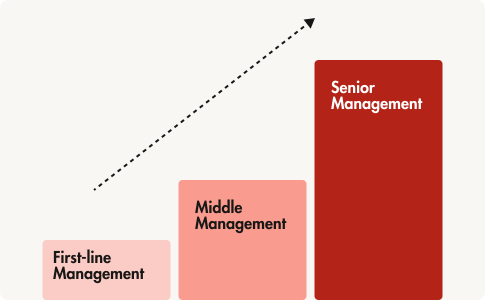
The Company has designed specific IDPs appropriate for each management level, divided into 3 main groups, namely;
-
1First-line Management
-
2Middle Management
-
3Senior Management
The development plan is designed to align with the organizational strategy and the personnel development needs of all departments, in order to strengthen personnel at all levels and support the sustainable business operations and growth of the organization.
Manager Development Program for Junior Managers
The Company has developed the Manager Development Program (MDP), an initiative focused on enhancing the potential of entry-level managers. It aims to prepare them for advancing to higher management roles. The program is designed on a holistic development basis, covering professional expertise, strategic thinking, team management, and maintaining operational standards.

Participants in the program will develop essential skills in situational analysis, specialized expertise in their respective fields, setting management direction, and operational planning that connects organizational goals to execution. Furthermore, it emphasizes the development of team management skills, including analyzing and improving team members' potential, motivation building, and managing internal team relationships.
Program participants will have the opportunity for hands-on practice to hone the learned skills through simulations, teamwork, and project presentations to the committee. A system for ongoing monitoring and evaluation is also in place throughout the program to ensure that entry-level managers and master's degree holders who complete this program possess sufficient knowledge, competence, and experience to advance to senior management and can effectively and sustainably apply their skills in their respective managerial duties.
Middle Management Development Program (MMDP)
The Company has developed the Middle Manager Development Program (MMDP), an initiative to enhance the potential of middle managers. It focuses on developing strategic management skills and effectively driving the organization toward its goals. The program aims to provide training that comprehensively covers the necessary competencies and skills for middle management, concentrating on 3 key areas:


Strategic Planning and Management
Middle managers must possess systems thinking skills, the ability to analyze the organizational environment, and set strategic direction that aligns with operational plans. They must also effectively translate strategy into action to meet key sustainable organizational goals and direction. This involves a focus on developing skills in work development planning, team management, and continuous development of team potential.

Risk Management
The program enhances skills in assessing and managing risks at the departmental level, situational analysis, and strategic decision-making under conditions of uncertainty. Furthermore, managers are developed in communication with the workforce and the long-term direction of the organization, building a shared vision, and driving change within the organization.

Driving the Organization towards Sustainability
To encourage managers to participate in and drive the organization towards sustainability, by focusing on creating value for stakeholders through developing team management and building successors for key positions within the organization. This is to create a strong foundation for the organization's sustainable growth.
Senior Management Development Program (SMDP)
The Company has developed the Senior Management Development Program (SMDP) to enhance the potential of senior executives, who play a crucial role in setting the direction and driving the organization toward sustainable success. This program is designed to cover various core competencies necessary for senior management


Long-term Strategic Planning.
The executives will be developed with skills in macro-level strategic thinking, analyzing future trends, and assessing both internal and external organizational environmental factors, as well as setting a clear vision and strategies for growth opportunities and creating a competitive advantage to build a foundation of sustainability for the organization.

Strategic Risk Management.
The program aims to develop the ability to assess and manage risks at the organizational level, make decisions under conditions of high uncertainty, and oversee change management. Executives will gain knowledge on establishing a risk management system that comprehensively covers the dimensions of finance, operations, and organizational sustainability.

Developing Systems and Personnel for Sustainability.
This is another crucial strategy within the program that impacts growth, the establishment of a strong corporate culture, and the support of strategic human resource management. Executives will gain skills in managing personnel from the operational level up to the succession of key roles. This also includes the effective development of leadership skills, employees, and change management.
Stakeholders Directly Impacted

Shareholders
Benefits Received
- Receive increased return on investment (ROI) because employees are efficient and drive the business with high potential.
Potential Impacts
- If personnel development is inadequate, it may lead to reduced operational efficiency and financial performance falling short of targets.

Customers
Benefits Received
- Receive higher-quality services, as employees possess up-to-date skills and knowledge.
Potential Impacts
- If employees lack the necessary skills, it may result in a decrease in service quality, impacting customer satisfaction and loyalty.

Business Partners
Benefits Received
- Smooth collaboration, with mutual understanding and effective coordination.
Potential Impacts
- If employees lack skills in communication or collaboration/coordination, it may cause delays and issues in project execution.

Communities and Society
Benefits Received
- Benefit from having quality personnel and participating in social projects.
Potential Impacts
- If there is no personnel development, it may reduce participation in community and social activities and lead to a diminished corporate image.

Government and Others Agencies
Benefits Received
- Comply with requirements, laws, and labor standards correctly.
Potential Impacts
- If personnel do not understand the laws and regulations, it may lead to non-compliance and penalties/sanctions.

Employees
Benefits Received
- Receive opportunities for knowledge and skill development, and career advancement.
Potential Impacts
- If there is no personnel development, it may result in a lack of motivation, a high turnover rate, and a shortage of potential personnel in the long term.
Project Highlights